Right price for the right product? Only if you know the products well.
By Valley Green Tea
Posted On January 9, 2020
A gold question in the tea community
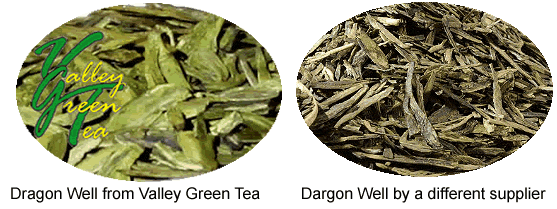 There is a gold question in the tea community – does the price of a product reflect its quality?
It is generally expected there is a relatively linear correlation between a product quality and its price.
I have however come across two separate incidences recently, one relating to Pu-erh tea and the other to Yixing Zisha teapot, that this correlation is put into serious test. Before event referring to the product quality, the consumers in both cases believed the prices were too cheap for the products to be genuine or of premium quality or authentic – in these cases a fair judgement. On the flip side however, it implies if the vendors were to simply put an additional ‘0’ at the end of the price tag, the products would attract immediate attention without any value added.
It then comes down to the crucial element which is the consumer’s capacity to discern the quality of a product. It is not only subjective, but also influenced by multiple factors such as personal experiences, preference, cultural background and marketing strategies by the vendors etc.
Premium loose teas (including all six categores: green tea, white tea, Yellow tea, Oolong tea, black tea and Pu-erh/Hei Cha) and certain tea accessories (eg Yixing Zisha teapots) are largely hand processed or handmade and quality graded, but not standardised. They are then traded under the ‘free market’ conditions which means the selling price is negotiated between the vendors and buyers, and highly sensitive to demand and availability.
Various efforts have been attempted to standardise the qualities of the products in order to better regulate the industry. It has however been difficult as the products are not as clear cut as for example the machine-made industrial products with a clear set of criteria to be measured against.
Summary:
Tea consumption is lifetime personal journey. It takes time and experiences for the individuals to appreciate the internal quality of certain products, and subsequently the right prices for the products.
For the beginners however, it is important to be aware that what you pay is not always what you get.
Recent Articles
-
Can I drink white tea every day?
Absolutely! The Chinese say it is Ok not to have food for 3 days, but not without tea for a day. Like all other Chinese teas, green tea, yellow tea,…
-
Pu-erh white frost vs mould
I was again approached by a customer today to say there was some ‘mould’ discovered on an aged Pu-erh tea cake received, which is actually the ‘white frost’. I thought…
-
Is Ok to drink green tea every day?
Green tea has had a consumption history in China for more than 2000 years. The Chinese say “it is Ok to go with food for 3 days, but not without…
-
Is it Ok to drink Jasmine tea every day
Absolutely. Jasmine tea has been consumed in China for nearly 800 years, especially in certain regions such as the Fuzhou area of the Fujian province. Tea is food in China….
-
Green teas handmade vs machine-made
Green teas have been traditional hand made in China and Japan for millenniums. It is labor intensive and inevitably keeping the tea prices up. I have recently visited a green…
-
How to tell a Pu-erh quality by its wet leaves
A well aged Pu-erh tea is a sought-after product in the Pu-erh community. There are various methods however to make a Pu-erh tea looking like aged, eg high temperature &…