How important is oxygen in Pu-erh’s conversion?
By Valley Green Tea
Posted On January 13, 2019
We are all aware of the fact that the older a Pu-erh is, the better the quality. There are currently two options to acquire a well aged Pu-erh:
1. Buy it from a vendor, which is often expensive
2. Purchase young and store to age
The storage conditions are however crucial, they can make or break a tea. There are abundant theories out there speculating on the ideal conditions for a Pu-erh to age and convert: humidity, temperature and oxygen levels etc. There is however not so black and white when it comes to apply them in real life.
There has been an interesting article published recently about a an interesting experiment.
Method (www.puercn.com, Author: Yang Zhong Yue)
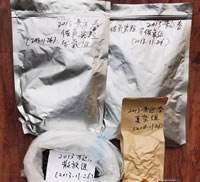
Four samples were created in 2013 using the same product, a fresh Jingmai (景迈) Gushu Pu-erh Maocha:
- One vacuum sealed
- One sealed, buy not vacuumed
- One sealed, buy injected oxygen on a regular base
- One natural open storage
All four samples were stored in a storage with a humidity machine for 4 years – the machine starts extracting extra humidity after it has exceeded 70%.
Results
- The vacuum sealed Pu-erh sample: The colour has converted nicely into golden red, aroma strong in both dry leaf and tea brew. The downside is that it is very bitter, the most bitter one of the four samples.
- The sealed but not vacuumed sample: good colour – golden red; Good aroma, but slightly less than the vacuum sealed sample; Significant reduction in bitterness and astringency.
- Oxygen injected sample: Colour gold, less red than the previous two; Aroma OK, but not as strong as previous two. Bitterness and astringency reduced, more than the vacuumed one, but similar to the non-oxygen injected one.
- Natural open stored sample: Colour gold, similar to the oxygen injected one; Very little aroma remained; There is some reduction in bitterness and astringency, but not as much as the sealed non-vacuumed one.
Summary
- Vacuuming is good to keep the Pu-erh teas in their original state, eg sample keeping, but not for consumption purpose ageing.
- Oxygen did not appear to have significant impact on the Pu-erh tea’s conversion, illustrated by the results of the oxygen injection and the natural open storage sample.
- There has been an active and ongoing internal conversions regulated by the internal enzymes of the tea leaves under the sealed conditions, result in rather satisfactory reduction of bitterness and astringency and colour conversion, without losing the aroma as the open stored sample.
- The author acknowledged that this comparison was only conducted 4 years after the storage, longer term differences of the storage impacts on the Pu-erh teas are yet to be studied.
Recent Articles
-
Can I drink white tea every day?
Absolutely! The Chinese say it is Ok not to have food for 3 days, but not without tea for a day. Like all other Chinese teas, green tea, yellow tea,…
-
Pu-erh white frost vs mould
I was again approached by a customer today to say there was some ‘mould’ discovered on an aged Pu-erh tea cake received, which is actually the ‘white frost’. I thought…
-
Is Ok to drink green tea every day?
Green tea has had a consumption history in China for more than 2000 years. The Chinese say “it is Ok to go with food for 3 days, but not without…
-
Is it Ok to drink Jasmine tea every day
Absolutely. Jasmine tea has been consumed in China for nearly 800 years, especially in certain regions such as the Fuzhou area of the Fujian province. Tea is food in China….
-
Green teas handmade vs machine-made
Green teas have been traditional hand made in China and Japan for millenniums. It is labor intensive and inevitably keeping the tea prices up. I have recently visited a green…
-
How to tell a Pu-erh quality by its wet leaves
A well aged Pu-erh tea is a sought-after product in the Pu-erh community. There are various methods however to make a Pu-erh tea looking like aged, eg high temperature &…