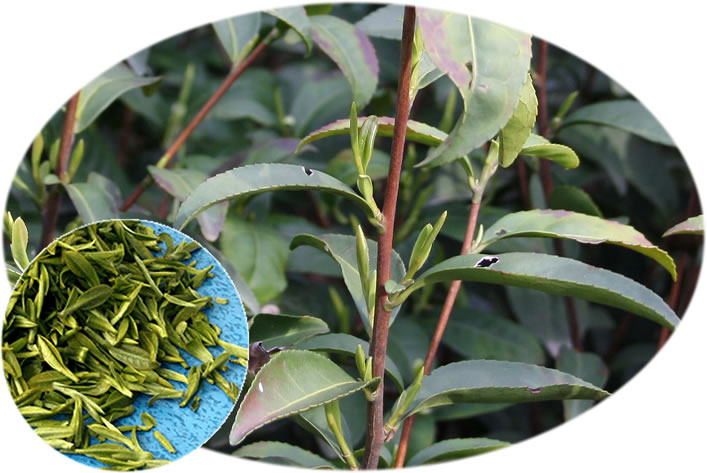
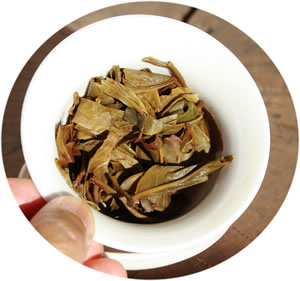
Pu-erh tea leaves and Plants
By Valley Green Tea
Posted On April 9, 2008
Pu-erh tea is named after its place of origan, the Pu-erh village in China’s Yun Nan province.
It is made using local tea trees which have the following differences in characteristics from traditional tea plants, despite all belong to the same plant family (Camellia Sinesis) as other tea plants:
-
Pu-erh tea arbour trees (Assamica) are significantly larger than normal tea plants (tea shrubs or bushes). The actual size of tea tree varies depending on its age.
-
The tea leaves are larger: they measure upwards of 20cm, with the normal leaves measure at typically around 5 cm or less.
-
The traditional Pu-erh trees were wild, found in local forests: Gu Shu (古树 ancient tea trees) defined as trees over 100 years old with some over 500 years.
The selection of the tea leaves and method used to process Pu-erh tea is therefore also different:
- good quality green tea and white are made of very young top tip leaves, normally only the buds or one bud and one opened leaf. The quality decreases with the inclusion of the leaves further down the branches. These teas are light, refreshing, aromatic, mellow with exquisite complex refreshing aftertaste.
- Oolong teas (semi-fermented) on the other hand, are made of more mature tea leaves. They are richer in color and brew and tend to be more aromatic.
- Black teas are fully fermented with very smooth texture and full body flavour.
- Pu-erh tea tea leaves are harvested from tea trees (Camellia sinensis Assamica) and the tea leaves are much bigger, up to 25 cm. The young and tip leaves are sorted and processed differently:
- Very young tip leaves are often made into lose leaf tea. The appearance will be: very fine tip tea leaves covered by glossily white/gold color fur. The description used for the taste of these teas is ‘mellow and smooth’, sometimes slightly bitter. These teas are more suitable to be consumed young in comparison to those made of mature tea leaves.
- The more mature or broken tea leaves are often compressed into Pu-erh tea cakes (or Tuo Cha & bricks). These teas are suitable for further ageing, should they be raw or ripened. The mature tea leaves combined with limited amount of twigs provide structural and substantial base for aged Pu-erh’s long term conversion and maturity. aged Pu-erh tea’s richly aromatic and mellowing taste. (There are ways to distinguish good quality and poor quality Pu-erh cakes too!)
In summary, Pu-erh tea made of mature leaves is not necessary of low quality like the other teas. It is one of the teas that it takes time and patience to experience the different varieties and choice that one you prefer.
Click here to order Pu-erh tea .
Recent Articles
-
Can I drink white tea every day?
Absolutely! The Chinese say it is Ok not to have food for 3 days, but not without tea for a day. Like all other Chinese teas, green tea, yellow tea,…
-
Pu-erh white frost vs mould
I was again approached by a customer today to say there was some ‘mould’ discovered on an aged Pu-erh tea cake received, which is actually the ‘white frost’. I thought…
-
Is Ok to drink green tea every day?
Green tea has had a consumption history in China for more than 2000 years. The Chinese say “it is Ok to go with food for 3 days, but not without…
-
Is it Ok to drink Jasmine tea every day
Absolutely. Jasmine tea has been consumed in China for nearly 800 years, especially in certain regions such as the Fuzhou area of the Fujian province. Tea is food in China….
-
Green teas handmade vs machine-made
Green teas have been traditional hand made in China and Japan for millenniums. It is labor intensive and inevitably keeping the tea prices up. I have recently visited a green…
-
How to tell a Pu-erh quality by its wet leaves
A well aged Pu-erh tea is a sought-after product in the Pu-erh community. There are various methods however to make a Pu-erh tea looking like aged, eg high temperature &…