Object contamination in teas
By Valley Green Tea
Posted On December 17, 2018
Object contamination in teas is not uncommon: strings, tarpaulin pieces, bamboo pieces, corn kernels, more serious ones even, feathers, hair and metal objects.
Sources of these contamination
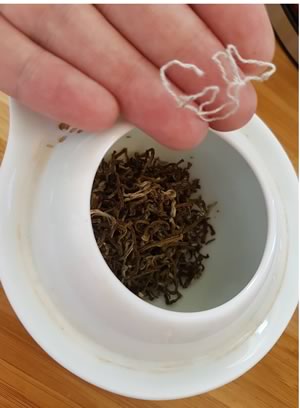 The reason for this is that most of premium Chinese teas, green tea, white tea, black tea, jasmine tea or Pu-erh tea, are hand handled: harvested by hands, dried in the open air on bamboo trays or tarpaulin mats, and processed in many stages with different equipment, eg bamboo cylinders. Unless they are factory mass produced, the traditional hand processing method also often occurs in villages in family workshops or small factories. This opens up the possibility that sometimes the small broken piece of the equipment or packaging materials, or air born objects in the environment can fall into the teas while being processed. The most obvious ones would have been picked up during the processing. The teas that are in certain forms, such as the compressed Pu-erh cakes or bricks, the objects can be hidden and retained until their consumption.
How to overcome the potential health hazard
To overcomes these down sides of hand made teas, we recommend:
- Inspect the loose teas carefully before brewing to pick out anything that doesn’t look like part of the tea.
- Rinse the tea leaves with hot water for 5-10 seconds before brewing.
Recent Articles
-
Can I drink white tea every day?
Absolutely! The Chinese say it is Ok not to have food for 3 days, but not without tea for a day. Like all other Chinese teas, green tea, yellow tea,…
-
Pu-erh white frost vs mould
I was again approached by a customer today to say there was some ‘mould’ discovered on an aged Pu-erh tea cake received, which is actually the ‘white frost’. I thought…
-
Is Ok to drink green tea every day?
Green tea has had a consumption history in China for more than 2000 years. The Chinese say “it is Ok to go with food for 3 days, but not without…
-
Is it Ok to drink Jasmine tea every day
Absolutely. Jasmine tea has been consumed in China for nearly 800 years, especially in certain regions such as the Fuzhou area of the Fujian province. Tea is food in China….
-
Green teas handmade vs machine-made
Green teas have been traditional hand made in China and Japan for millenniums. It is labor intensive and inevitably keeping the tea prices up. I have recently visited a green…
-
How to tell a Pu-erh quality by its wet leaves
A well aged Pu-erh tea is a sought-after product in the Pu-erh community. There are various methods however to make a Pu-erh tea looking like aged, eg high temperature &…