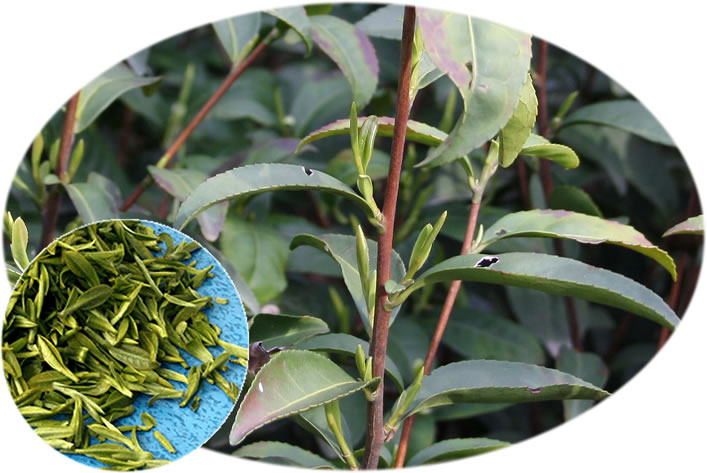
Green tea plants and leaves
By Valley Green Tea
Posted On February 25, 2011
 All conventional teas (with the exception of herbal teas) are made from a species of plant called Camellia sinensis. Premium green teas are made from the very young tea leaves of the plants. Tea bushes are typically trimmed after each harvest. During the following spring season, the young shoots start appearing between the mature leaves left from the previous harvest and their stems (shown in the image). Only these new shoots are harvested to be made into premium green teas; (low quality commercial teas use any leaves, while the commercial teabags use tea dust.)
The green tea harvest lasts over a month. Apart from many other conditions associated with the quality of the tea leaves, such as the geographic location of the plantations, soil condition, rainfall and sunshine during the year, the timing of these leaves’ harvest is also crucial. For example, teas made from leaves harvested before Qing Ming (one of the 24 seasons of the Chinese calendar in early spring) could fetch 10 times the price of teas made from leaves harvested at the end of the season, even though they are from the same plantation. The pre-Qing Ming tea production is, however, very limited, as the weather is normally cold and the leaves grow very slowly.
 A green tea farmer’s tale:
Here is a little secret whispered into my ears by a retired Long Jing (Dragon Well) green tea farmer (pictured on the left) during my 2010 visit to Long Jing valley. This farmer told me quietly: ‘when you go looking for premium Long Jing, look at the length of the stem between the top two leaves. The ones with longer distances indicate that they grow on the mountains of a higher altitude. The temperature is lower up there and the tea plants do not grow as fast. This allows the leaves to take time to stock up all the nutrients and flavours and they are therefore of better quality.’ This ‘secret’ may or may not be recorded in the university’s text books, it certainly has been recorded in my knowledge collection of teas written while travelling to different tea producers and farmers. 
En Jie’s pick of green tea
The process of premium green tea harvesting is mostly done by hand and is labour intensive. (There are tea manufacturers now use machines for mass harvesting and the teas produced are generally considered not as good).
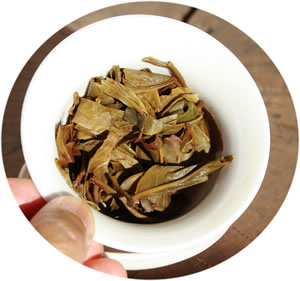
I joined in for a morning’s tea picking of the Dragon Well green tea and the result is illustrated by this image (on the right). The dry tea produced from these leaves weighed barely 20g!
Recent Articles
-
Can I drink white tea every day?
Absolutely! The Chinese say it is Ok not to have food for 3 days, but not without tea for a day. Like all other Chinese teas, green tea, yellow tea,…
-
Pu-erh white frost vs mould
I was again approached by a customer today to say there was some ‘mould’ discovered on an aged Pu-erh tea cake received, which is actually the ‘white frost’. I thought…
-
Is Ok to drink green tea every day?
Green tea has had a consumption history in China for more than 2000 years. The Chinese say “it is Ok to go with food for 3 days, but not without…
-
Is it Ok to drink Jasmine tea every day
Absolutely. Jasmine tea has been consumed in China for nearly 800 years, especially in certain regions such as the Fuzhou area of the Fujian province. Tea is food in China….
-
Green teas handmade vs machine-made
Green teas have been traditional hand made in China and Japan for millenniums. It is labor intensive and inevitably keeping the tea prices up. I have recently visited a green…
-
How to tell a Pu-erh quality by its wet leaves
A well aged Pu-erh tea is a sought-after product in the Pu-erh community. There are various methods however to make a Pu-erh tea looking like aged, eg high temperature &…