Pu-erh cakes, bricks, Tuo Cha and loose, what are the differences?
By Valley Green Tea
Posted On January 14, 2018
Understand the very basics of Pu-erh shapes
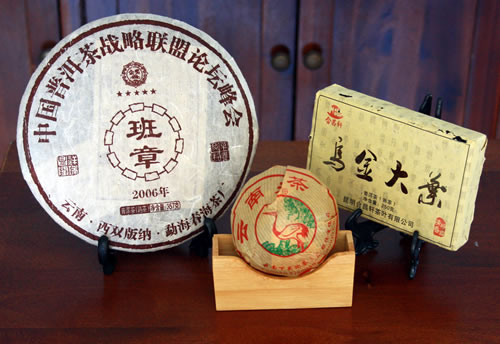 To understand the difference, we need to start from understanding the teas were compressed into different shapes initially as a mean for convenient transportation, but not to achieve different tastes. The different pu-erh tea producing areas of Yunnan have different local traditions regarding the shapes to compress, eg Xia Guan is known to produce Tuo Cha although it also produces cakes and bricks.
The differences:
With this understanding, following are some end result variations:
- If say we used exact the same crop for loose, Tuo Cha, bricks and cakes, the strength in flavour from light to strong: loose -> Tuo Cha -> cake and brick. This is largely due to the fermentation level affected by the surface areas in contact with the air and oxygen. (Loose most and cake/brick least.)
- Big manufacturers, such as Da Yi and Xia Guan, these days compress cakes using leaves/crops from different sources and ares. Some relatively cheap cakes even use lower grade leaves inside and ‘cover’ the surface with a layer of higher grade leaves for the purpose of appearing to the consumers.
- The traditional bricks are made of more proportion of twigs and tea dust than cakes or Tuo Cha.
- Regardless of the shape, all high quality Pu-erh should own up to a high quality Pu-erh’s characteristics.
Recent Articles
-
Can I drink white tea every day?
Absolutely! The Chinese say it is Ok not to have food for 3 days, but not without tea for a day. Like all other Chinese teas, green tea, yellow tea,…
-
Pu-erh white frost vs mould
I was again approached by a customer today to say there was some ‘mould’ discovered on an aged Pu-erh tea cake received, which is actually the ‘white frost’. I thought…
-
Is Ok to drink green tea every day?
Green tea has had a consumption history in China for more than 2000 years. The Chinese say “it is Ok to go with food for 3 days, but not without…
-
Is it Ok to drink Jasmine tea every day
Absolutely. Jasmine tea has been consumed in China for nearly 800 years, especially in certain regions such as the Fuzhou area of the Fujian province. Tea is food in China….
-
Green teas handmade vs machine-made
Green teas have been traditional hand made in China and Japan for millenniums. It is labor intensive and inevitably keeping the tea prices up. I have recently visited a green…
-
How to tell a Pu-erh quality by its wet leaves
A well aged Pu-erh tea is a sought-after product in the Pu-erh community. There are various methods however to make a Pu-erh tea looking like aged, eg high temperature &…