How to remove the paper on a Pu-erh cake (Nei-Fei) effortlessly
By Valley Green Tea
Posted On March 5, 2020
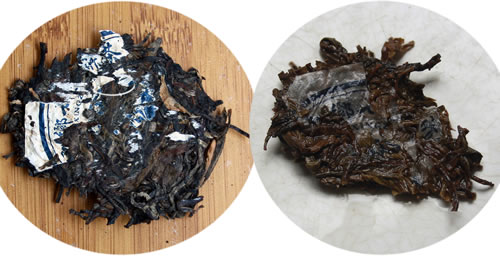
 There is a tradition to attach a piece of paper called Nei-Fei (内飞) to a Pu-erh tea cake/brick with some brief information about the making of cake. The Nei-Fie is normally superficially embedded on the top of a cake under a thin layer of the tea leaves (as shown in the image). The paper is often difficult to remove as it has been compressed under a thin layer of the tea leaves when that cakes were made, glued to the cake by the tea glue released during the steaming and compression (which also glue the tea leaves together into a cake).
A quick and easy to remove the paper:
- Do NOT attempt to remove the paper when it is dry
- Break up the Pu-erh cakes as usual and break off the amount of the tea leaves you would normally use for a tea section
- Put the piece/pieces with the Nei-Fei attached in the tea vessel for brewing, a pot, a mug or a Gaiwan, add hot water to it and sit for about 10 seconds.
- Remove the tea from the hot water and leave on a plate to cool down.
- The paper now can be easily removed with a sharp object, such as a folk or a Pu-erh knife. (See below)
Recent Articles
-
Can I drink white tea every day?
Absolutely! The Chinese say it is Ok not to have food for 3 days, but not without tea for a day. Like all other Chinese teas, green tea, yellow tea,…
-
Pu-erh white frost vs mould
I was again approached by a customer today to say there was some ‘mould’ discovered on an aged Pu-erh tea cake received, which is actually the ‘white frost’. I thought…
-
Is Ok to drink green tea every day?
Green tea has had a consumption history in China for more than 2000 years. The Chinese say “it is Ok to go with food for 3 days, but not without…
-
Is it Ok to drink Jasmine tea every day
Absolutely. Jasmine tea has been consumed in China for nearly 800 years, especially in certain regions such as the Fuzhou area of the Fujian province. Tea is food in China….
-
Green teas handmade vs machine-made
Green teas have been traditional hand made in China and Japan for millenniums. It is labor intensive and inevitably keeping the tea prices up. I have recently visited a green…
-
How to tell a Pu-erh quality by its wet leaves
A well aged Pu-erh tea is a sought-after product in the Pu-erh community. There are various methods however to make a Pu-erh tea looking like aged, eg high temperature &…