Green tea, white tea, Oolong tea, what are they and what are the differences?
By Valley Green Tea
Posted On May 4, 2017
Green tea, white tea, Oolong tea, what are they and what are the differences?
This is a question that I have been asked repeatedly, by both experienced and naive tea drinkers.
Fermentation is the key
The answer to the question is probably simpler than what is expected: teas are categorised largely based on one crucial aspect during the tea processing, which is fermentation.
Teas have been consumed in China for more than 2000 years. The traditional tea producing areas have all developed their own skills to process their local teas: cultivate and harvest the teas under the local environmental conditions, produce the teas that are suitable for consumption with the local diet and climate. Thus, a big variety of teas have been created. For example, there are more than 300 green teas alone produced in China.
Chinese teas on a scale
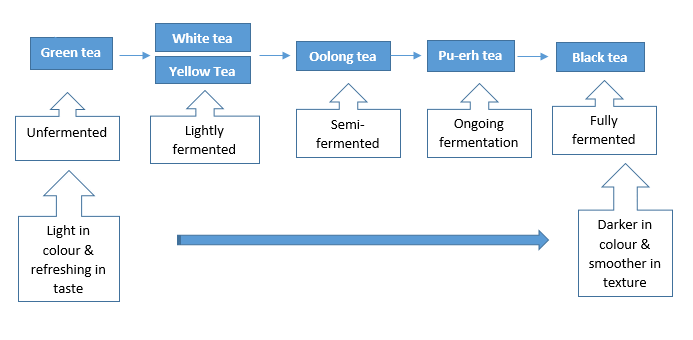
Tea processing is a highly skillful process with many steps and crafts and mastering them is crucial to producing the quality end products. There is however one aspect that differentiates the various classes of teas which is the level of fermentation. Tea fermentation can be viewed as a scale:
- The scale starts from one end where the teas are not fermented at all – this includes all the green teas
- The other end of the scale includes teas that are fully fermented – all black teas
- In the mid is the class called Oolong tea. Oolong teas are semi-fermented. There are many teas in this family and different Oolong teas are fermented to various degrees. For example, Tie Guan Ying Oolong tea is less fermented than Wu Yi Oolong.
- The in-between categories:
- White tea: lightly fermented but least processed, there is no rubbing, pressing or rolling of the tea leaves during the tea making
- Yellow tea: lightly fermented with an additional step called ‘Wo Huang’ – a deliberate prolonging of a green tea leaves sitting stage to turn the leaves into a deeper yellow colour.
- Pu-erh tea (compressed tea): the teas are partially fermented when made and continue to ferment after their production.
The level of fermentation has profound effect on a tea’s appearance, aroma, brew colour, texture and taste.
Recent Articles
-
Can I drink white tea every day?
Absolutely! The Chinese say it is Ok not to have food for 3 days, but not without tea for a day. Like all other Chinese teas, green tea, yellow tea,…
-
Pu-erh white frost vs mould
I was again approached by a customer today to say there was some ‘mould’ discovered on an aged Pu-erh tea cake received, which is actually the ‘white frost’. I thought…
-
Is Ok to drink green tea every day?
Green tea has had a consumption history in China for more than 2000 years. The Chinese say “it is Ok to go with food for 3 days, but not without…
-
Is it Ok to drink Jasmine tea every day
Absolutely. Jasmine tea has been consumed in China for nearly 800 years, especially in certain regions such as the Fuzhou area of the Fujian province. Tea is food in China….
-
Green teas handmade vs machine-made
Green teas have been traditional hand made in China and Japan for millenniums. It is labor intensive and inevitably keeping the tea prices up. I have recently visited a green…
-
How to tell a Pu-erh quality by its wet leaves
A well aged Pu-erh tea is a sought-after product in the Pu-erh community. There are various methods however to make a Pu-erh tea looking like aged, eg high temperature &…